
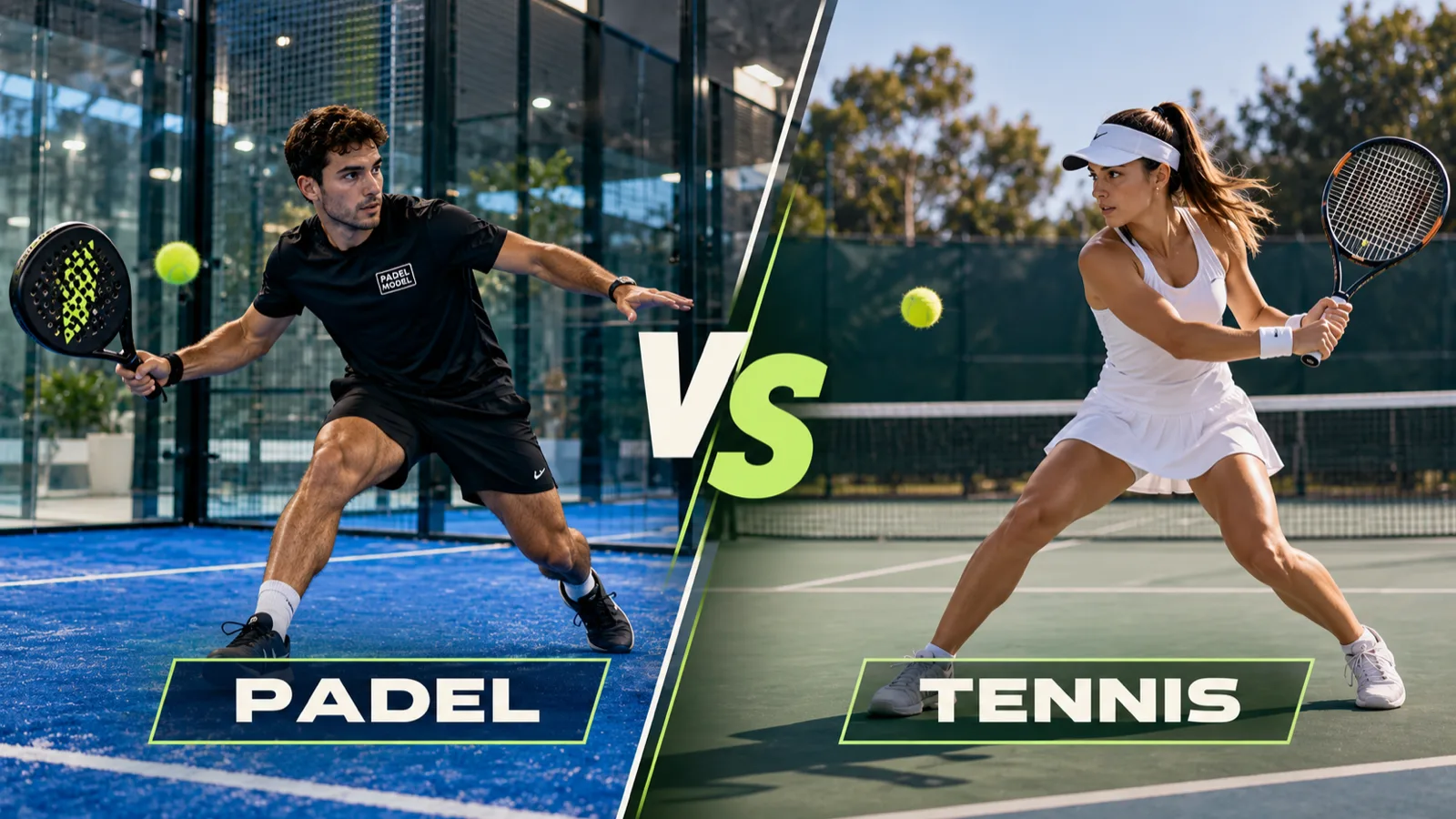
If you enjoy sports that combine movement, coordination, strategy and competition, you have probably heard of both padel and tennis. Although they share some similarities, they offer surprisingly different playing experiences. This guide compares the two, explains their main differences, and helps you decide which one is right for you. If you are new to the sport, you can also explore our [complete guide to padel, its history, rules and equipment](/history) to understand how the game works.
Padel vs Tennis: What Are the Main Differences?
The biggest difference between padel and tennis is how players use the court. Tennis is played on an open court, while padel is played on an enclosed court surrounded by glass and mesh walls. In padel, the ball can rebound off the glass after bouncing on the court and remain in play, creating longer rallies and adding a tactical dimension.
Here is how the two sports compare at a glance:
- Court: padel uses a smaller, enclosed court; tennis uses a larger, open court.
- Dimensions: a padel court is 20 m × 10 m; a tennis court is 23.77 m long, with the width varying for singles or doubles.
- Walls: in padel the glass and mesh walls are part of the game; in tennis they are not.
- Racket: padel uses a solid, perforated racket with no strings; tennis uses a strung racket.
- Serve: padel is served underhand after a bounce; tennis is served overhand.
- Format: padel is usually doubles with four players; tennis is singles or doubles.
- Strategy: padel rewards positioning, teamwork, angles and wall play; tennis rewards shot placement, movement, power and court coverage.
Both sports can improve fitness, coordination and competitive skills. The right choice depends on what you want from your playing experience.
Court Size and Design: Padel vs Tennis
How big is a padel court?
A standard padel court measures 20 metres long and 10 metres wide. It is enclosed by glass and mesh walls, which become part of the game. The smaller playing area keeps players involved and rewards positioning, control and teamwork.
How big is a tennis court?
A standard tennis court measures 23.77 metres long. It is 8.23 metres wide for singles and 10.97 metres wide for doubles. Tennis has no playing walls, so players rely on court coverage, footwork, shot depth and the ability to move opponents around the court.
Which court is better for beginners?
Neither court is inherently better. Padel’s smaller court can make it easier for beginners to stay involved in a rally, particularly when playing doubles. Tennis offers a different challenge for players who enjoy covering distance and developing powerful groundstrokes.
Padel Rackets vs Tennis Rackets
What does a padel racket look like?
A padel racket is solid and has no strings. Its hitting surface contains small holes, and its compact shape supports controlled shots and quick reactions. Rackets vary in shape, weight, balance and material. Beginners do not need expensive equipment to get started.
How is a tennis racket different?
A tennis racket has a strung hitting surface that helps players generate power, spin and different shot trajectories. Tennis rackets vary in weight, head size, string pattern and balance.
Do you need your own racket to play padel?
No. Renting equipment is a practical way to try the sport before investing in your own gear. At Padel Model, explore the available court and racket rental options before planning your first session.
Rules and Scoring: How Different Are They?
Padel and tennis share many scoring conventions, including the familiar 15, 30, 40 and game system. The main differences come from serving, the walls and how the ball can be returned.
How does serving work in padel?
The padel serve is underhand. The server lets the ball bounce on the ground and strikes it at or below waist height while following the serving rules. The ball must travel diagonally into the opponent’s service box. In tennis, the serve is generally an overhead shot delivered from behind the baseline into the diagonally opposite service box.
How do the walls change padel?
After the ball bounces on the opponent’s court, it can rebound off the glass or mesh and remain playable, provided the shot follows the rules. Players must learn to anticipate rebounds and decide when to move toward the ball or allow it to come off the glass. Learn more in our padel rules and game guide.
Is Padel Easier Than Tennis?
For many beginners, padel can feel more accessible during the first few sessions. The smaller court, underhand serve and doubles format can help new players get involved without needing advanced technique immediately.
However, padel is not easy to master. As players improve, they need accurate shot placement, effective positioning, anticipation, communication and an understanding of wall rebounds. Advanced padel can be highly tactical.
Why beginners often enjoy padel
- A manageable court size: players cover a smaller enclosed area.
- An underhand serve: easier to approach for people new to racket sports.
- Doubles play: teammates share court coverage and learn together.
- Wall rebounds: the glass creates extra opportunities to keep rallies going.
- A social atmosphere: playing with a partner encourages communication.
Can you play padel without playing tennis first?
Absolutely. Tennis experience is not required. You can learn basic racket control, serving, positioning and wall play from scratch. Explore the beginner padel programs at Padel Model for structured guidance.
Fitness Benefits: Which Sport Gives You a Better Workout?
Both sports can provide an enjoyable workout. Intensity depends on fitness level, session length, pace and match format.
Padel involves short movements, changes of direction, quick reactions and coordinated play. Regular play can help practise agility, balance, reaction time, cardiovascular endurance and hand-eye coordination.
Tennis can involve more open-court movement, longer runs, powerful serves and repeated groundstrokes. It can challenge endurance, speed, balance, strength and coordination.
There is no universal winner. The best sport for staying active is often the one you enjoy enough to play consistently.
Can Tennis Players Easily Switch to Padel?
Tennis players often bring useful racket control, timing, ball tracking and movement skills to padel. However, they still need to learn padel-specific techniques.
- Wall play: learn to read rebounds and use the glass effectively.
- Patience: controlled placement can be more useful than power alone.
- Doubles positioning: understand where to stand and how to cover the court with a partner.
- Net play: recognise when to attack and when to defend.
- A different serve: focus on accurate underhand serving rather than copying a tennis serve.
Approaching padel as its own sport helps tennis players develop more effective habits.
Which Sport Is Better for Families and Groups of Friends?
Padel can be appealing for groups because four people can play together on one court. Beginners can learn fundamentals while sharing the experience with friends. Tennis is also versatile: singles suits two players, while doubles allows four to play together.
For families, consider suitable coaching, equipment, ages and the participants’ abilities. If you are exploring padel as a family activity, check the current programs and training options at Padel Model.
Where Can You Play Padel in Richmond, BC?
Padel Model is an indoor padel club in Richmond, British Columbia, for players who want to play, train and become part of the sport’s local community. The club brings together indoor courts, coaching and training programs, equipment rental, and spaces where players can spend time before or after their matches.
Whether you are a complete beginner, an experienced tennis player or someone looking for a new social activity, explore Padel Model, Vancouver’s premier padel club, or read our guide to playing padel in Richmond, BC.
Padel vs Tennis: Which Sport Is Right for You?
Choose padel if you want
- A racket sport that is approachable for many beginners.
- A smaller court with glass walls that influence the game.
- A team-based experience, usually played in doubles.
- A combination of movement, tactics and communication.
- Opportunities to meet players through a club community.
Choose tennis if you want
- A traditional racket sport with singles and doubles formats.
- To develop powerful serves and groundstrokes.
- A game that involves covering a larger open court.
- To focus on individual performance in singles.
- To build on existing tennis skills or play tennis competitions.
You do not necessarily have to choose only one. Tennis and padel develop overlapping but distinct skills, and some players enjoy both sports. If you are curious about padel, you do not need to be an experienced athlete or own all the equipment before you begin — start by learning the basics, invite a few friends, and give yourself time to get comfortable on the court. When you are ready, contact Padel Model before your first visit.
No. Both are racket sports, but they differ in court design, equipment, serving and gameplay. Padel uses an enclosed court with glass and mesh walls, a solid racket and an underhand serve.
Many beginners find padel approachable because of its smaller court, underhand serve and doubles format. Becoming proficient still requires practice, particularly with wall play, positioning and tactics.
Yes. Beginners can learn the rules, basic shots, serving and court positioning through practice or structured coaching.
Both commonly use the traditional 15, 30, 40 and game scoring system. Match formats and certain scoring procedures can differ depending on the rules and competition.
Padel is usually played by four people, with two players on each team.
Yes. Tennis players often bring useful racket skills, but they still need to learn wall play, underhand serving and doubles positioning.
Yes. Padel involves movement, changes of direction, coordination and repeated reactions. Intensity depends on pace, ability and session length.
Padel Model offers indoor padel courts in Richmond, BC. Visit the Padel Model website to learn about the club, programs and booking information.
No. Renting a racket can be a convenient way to try the sport before buying equipment. Check the current court and racket rental options.
Yes. Explore the programs page to find available training options.
Padel vs tennis at a glance
- Court
- Padel: 20 m × 10 m, enclosed · Tennis: 23.77 m, open
- Walls
- Part of the game in padel; not in tennis
- Racket
- Padel: solid, no strings · Tennis: strung
- Serve
- Padel: underhand · Tennis: overhand
- Format
- Padel: usually doubles · Tennis: singles or doubles
- Beginners
- Padel is often quicker to start rallies
Ready to try padel?
You do not need tennis experience or your own gear. Bring a few friends, rent a racket if you need one, and learn padel as you play on Padel Model’s indoor courts in Richmond, BC.
Padel vs Tennis: Which Sport Is More Social?
Both sports can be social, especially in doubles. Padel is particularly associated with its four-player format. Teammates communicate about positioning, coordinate defensive movements and work together to create openings.
Tennis offers singles and doubles, along with clubs and leagues where players can meet others. A good club experience can make it easier to learn, find playing partners, improve skills and build a regular routine.
At Padel Model, the experience is designed around playing, training and community. Learn more on our About Padel Model page.