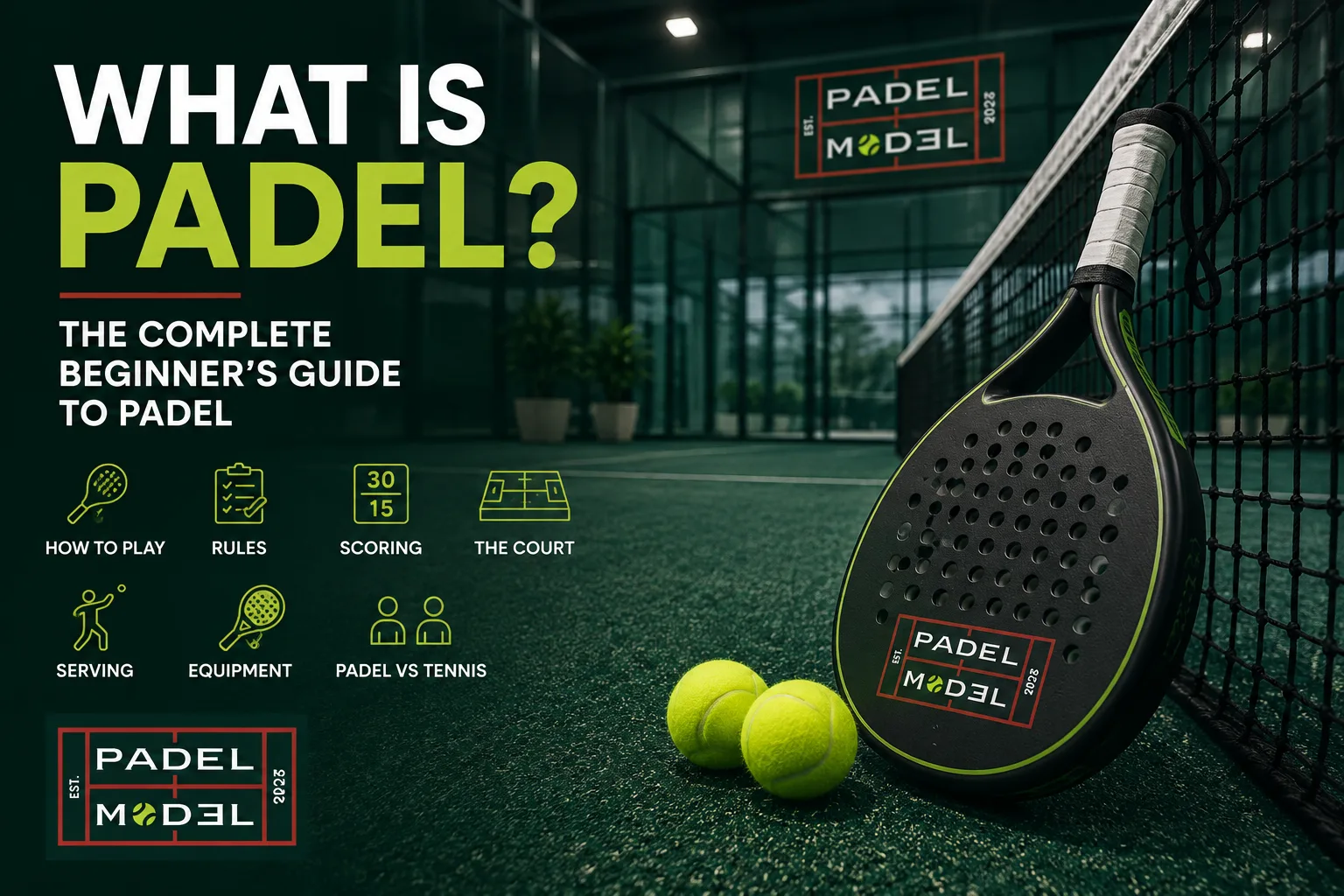
Padel is the fastest-growing racket sport in the world — and one of the easiest to pick up. This guide covers everything a first-time player needs: how the game works, the rules, the scoring, the court, the serve, the gear, and how padel differs from tennis.
What Is Padel?
Padel is a racket sport played on an enclosed court, most commonly by two teams of two players. The court measures 10 meters wide by 20 meters long and is surrounded by glass and mesh. Unlike tennis, the walls are an active part of rallies.
The objective is simple: hit the ball over the net so your opponents cannot legally return it before it bounces twice. Because the walls remain in play, a successful rally is not only about placing the ball into an open area. Players also use angles, rebounds, lobs, speed changes, and court position to create opportunities.
The International Padel Federation (FIP) is the sport’s world governing body and publishes the official rules used in organized padel. FIP currently has 100 affiliated national federations, reflecting how widely the sport has spread internationally.
One reason padel has become so popular is its accessibility. You do not need years of racket-sport experience to understand a basic rally. At the same time, the enclosed court creates a large tactical layer that rewards practice and teamwork.
How Do You Play Padel?
A standard padel match is played between two teams of two. Each team has a player on the left and right side of the court, and partners constantly adjust their positions together.
A point begins with a serve. The serving player must serve diagonally into the opponent’s service box. The rally continues after the return.
Once the ball has bounced on the opponent’s side, players can use the walls as part of the rally. This is one of the biggest differences between padel and tennis.
The goal is not simply to hit harder. Good padel players use controlled shots to move opponents, create space, and approach the net at the right time. At higher levels, teams often work together to control the net and force difficult defensive positions.
For a first session, focus on keeping the ball in play, learning the wall, moving with your partner, and using placement rather than trying to win every point with power.
Padel Rules for Beginners
The basic padel rules are easier to learn than they may appear. The scoring system resembles tennis, but the walls and serve create several differences.
Players serve diagonally, and the serve is made after the ball has bounced. The contact point must be at or below the waist, and the server must make the serve from the correct side of the court. Players normally get two service attempts.
During a rally, the ball must bounce on the opponent’s court before it can hit the surrounding wall or fence as part of a legal sequence. If the ball hits a wall or fence on the opponent’s side before bouncing, that is not a legal in-play rebound.
After a legal bounce, however, the ball can rebound from the walls and remain playable.
A team loses the point when, among other situations, it fails to return the ball correctly, allows the ball to bounce twice, or commits a fault such as touching the net during the point.
Beginners do not need to memorize every exception before their first game. Learning the core rally rules and then playing is usually the fastest way to understand the sport.
Padel Scoring Explained
Padel traditionally uses a tennis-style scoring structure: 15, 30, 40, and game. A team normally needs to win enough games to take a set, and matches are commonly structured around sets.
At 40-40, the game reaches deuce. Depending on the competition and the rules being used, the game may continue through advantage scoring or use an approved alternative format.
There is an important 2026 update for competitive padel. FIP introduced the Star Point as an alternative mechanism for games that reach deuce in its major competition circuits. The exact format depends on the competition, so recreational players should follow the scoring system announced by their club or event.
For beginners, remember the basic sequence: 15 → 30 → 40 → Game. The scoring can feel strange at first, but after a few games it becomes natural.
The Padel Court: Size, Walls, and Layout
A regulation padel court is 20 meters long and 10 meters wide. It is enclosed by walls and mesh, with glass commonly used in the back and side sections.
The enclosure is not decoration. It changes the sport completely.
In tennis, a ball that reaches the fence or wall is generally out of play. In padel, the walls can return the ball after a legal bounce, allowing rallies to continue and creating angles that do not exist on a traditional open court.
The net divides the court, while service lines define the areas used during the serve. Players also need enough space around the court for safe movement, particularly at facilities designed for higher-level play.
Understanding the walls is one of the biggest steps in learning how to play padel.
How to Serve in Padel
The padel serve is one of the sport’s most distinctive features.
Unlike a tennis serve, you do not normally throw the ball into the air and hit it overhead. The server first lets the ball bounce and then strikes it underhand, with the contact point below waist height.
The serve must travel diagonally into the opponent’s service box. The server alternates serving sides as required by the scoring sequence.
A good beginner serve is not necessarily a fast serve. The priority is accuracy, consistency, and creating a return that allows your team to establish a strong position.
A simple serving routine is: stand in the correct position, bounce the ball, strike it below waist height, send it diagonally into the correct service box, then recover quickly.
As you improve, experiment with placement, spin, speed, and direction.
Padel Equipment: What Do You Need?
You do not need a large amount of equipment to try padel.
The essential items are a padel racket, padel balls, comfortable sports clothing, and court shoes with suitable grip.
A padel racket is solid rather than strung like a tennis racket. It is usually perforated and designed specifically for the sport. Different shapes, weights, balances, and materials affect how a racket feels and performs.
For a first session, there is little reason to buy the most advanced racket available. Comfort and control matter more than having professional-level equipment.
If you are trying padel for the first time, check whether your club provides racket and ball rentals.
Padel vs Tennis: What’s the Difference?
Padel and tennis share familiar elements: rackets, a net, a ball, service, games, sets, and similar scoring language. But they feel very different once you start playing.
The most obvious difference is the court. A padel court is smaller and enclosed, while a tennis court is larger and open. Padel also normally uses doubles play, whereas tennis can be played as singles or doubles.
The racket is different too. A padel racket has no strings, while a tennis racket uses strings and has a larger hitting surface.
The serve is another major difference. Padel uses an underhand serve after a bounce, while tennis uses an overhand serve.
Then there are the walls. In padel, the walls are part of the strategy. This changes the pace of rallies and makes positioning extremely important.
Is Padel Easier Than Tennis?
For many beginners, padel feels easier to start than tennis. The smaller court reduces the amount of ground you need to cover, the underhand serve removes one of the more technically demanding parts of tennis, and doubles play gives each player a partner.
That does not mean padel is easy to master.
As your level increases, the game becomes highly tactical. Players learn how to defend using the walls, when to move forward, how to maintain formation with a partner, and how to construct points instead of simply hitting winners.
People who already play tennis often adapt quickly to padel, although tennis habits such as hitting every ball early or relying heavily on power may need to be adjusted.
Padel for Beginners: Your First Session
If you are wondering how to start playing padel, keep your first session simple.
You do not need to master the rules before stepping onto the court. Start by learning how to hold the racket, control the ball, return basic shots, and understand the boundaries.
Next, learn the basic court positions. In doubles padel, partners generally move together. If one player moves toward the net while the other stays far behind, a large gap can open between them.
Once you understand movement, begin learning the walls. Let the ball bounce, watch its path, and practice returning it after it comes off the back wall.
Finally, play points. Padel makes much more sense when you experience the rhythm of an actual rally.
If you are in Richmond or the Vancouver area, Padel Model offers a Beginner Program, intermediate training, private lessons, and group sessions.
Common Padel Mistakes Beginners Make
The fastest way to improve is often to stop doing a few predictable things.
- Trying to hit every ball hard: uncontrolled power often gives opponents an easy ball or sends the ball into the net.
- Standing too far apart: your position should usually work together with your partner’s.
- Ignoring the walls: the wall gives you time and options. Rushing forward to hit every ball can make defensive situations harder.
- Moving backward too much: learning when to hold position and when to use the wall is more effective.
- Trying to finish points too early: padel rewards patience. A good lob, controlled shot, or change of direction can create a better opportunity.
- Focusing only on your own shot: your partner’s position matters. Good communication and coordinated movement are central to doubles padel.
How Long Does It Take to Learn Padel?
You can learn the basic idea of padel in one session, but becoming a confident player takes practice.
Your first goal should be consistency. Learn to keep the ball in play, understand the basic scoring, serve legally, and move with your partner.
After that, work on the walls, lobs, volleys, positioning, and shot selection. Later, develop more advanced tactics such as controlling the net, targeting weaknesses, changing pace, and constructing points.
There is no single timeline because people arrive with different athletic and racket-sport backgrounds.
Why Is Padel So Popular?
Part of padel’s appeal is that it combines competition with a strong social element. Doubles play naturally creates interaction, and the smaller court makes communication between partners important.
It is also easy to introduce to new players. Someone can understand the basic objective quickly, play a short rally, and improve from there.
At the same time, experienced players have an almost endless tactical learning curve. The walls, court positioning, shot selection, partner coordination, and changing pace create layers that are not obvious during a first game.
FIP says it currently has 100 affiliated national federations, and its 2026 calendar includes more than 450 men’s and women’s tournaments across more than 60 countries. Padel has also been confirmed as a medal sport at the 2026 Asian Games.
Start Playing Padel
So, what is padel?
It is a doubles racket sport played on a 10-by-20-meter enclosed court where the walls become part of the game. It uses a solid, perforated racket, an underhand serve, and a scoring system closely related to tennis. But the real character of padel comes from how those elements work together.
You do not need to be an expert athlete or an experienced tennis player to start. Learn the basic rules, get comfortable with the court, practice your serve and returns, and pay attention to your position relative to your partner.
Then play.
The quickest way to understand padel is to step onto a court and experience the first rally for yourself.
If you are ready to try the sport in Richmond, BC, explore Padel Model’s programs for beginner, intermediate, private, and group training options. You can also learn more about the club, its indoor courts, membership options, and how to book your first session.
Padel is easy to discover. The fun is seeing how far you can take it.
Padel at a glance
- Court size
- 10 m × 20 m, fully enclosed
- Format
- Doubles — two teams of two
- Racket
- Solid and perforated, no strings
- Serve
- Underhand, below the waist, after a bounce
- Scoring
- 15 → 30 → 40 → Game, like tennis
- Walls
- In play after a legal bounce
Ready for your first rally?
Padel Model’s indoor courts in Richmond, BC are open to every level — rackets and balls included on your first visit.